
 polski
 English (UK)
 English (EU)
 Deutsch
 český
 slovenský
 magyar
 românesc
 français
 русский
 белорусский
 український

“We were looking for an electronic document workflow system and found a system that optimises many of our processes” – says Piotr Andrzejewski, CEO of BKF.
How did it start?
Growing interest in our offer translated into a growing number of orders. The resulting need to hire new staff, together with the increasing number of processes to handle, made us decide to go digital.
Initially we wanted to automate our document workflow to improve communication within the company and speed up repetitive tasks. It quickly turned out that many more of our processes would need to be digitised. So we had to choose software that would be scalable – in other words, software that would grow with us :).
For a moment we even considered writing our own solution. However, we knew that for a team of programmers and people who manage the production of touchless car washes every day, developing our own software would be unattractive and extremely expensive. That is why we leaned towards finding a platform that would meet our most important requirements.
In the end we chose a platform that is low-code, scalable and gives us unlimited integration options with the online platforms we were already using. Following this line of thinking, we came across JobRouter, a process automation platform. Having seen what it could do, we decided to buy it within 15 minutes.
“It was love at first sight” – comments Piotr Andrzejewski.
What did the implementation look like?
Working with the team at e-MSI, a certified partner of JobRouter AG, who carried out the pre-implementation analysis and then supplied and implemented JobRouter, everything went quite smoothly. We were given ready-made modules that we only had to select and tailor to our needs.
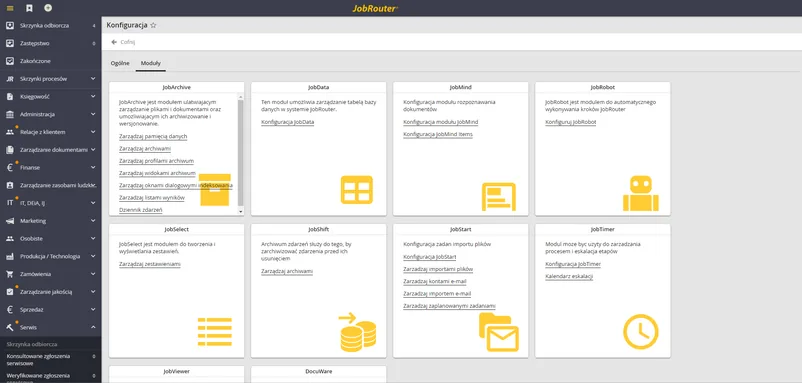
The platform we implemented includes the following modules:
- purchasing,
- production,
- shipping,
- technical,
- records,
- sales,
- billing and costs (order and electronic invoice workflow),
- analytics with reporting, analyses and statistics,
- electronic document workflow,
- Customer Relationship Management (CRM),
- Call Center (Focus Contact Center).
The system is integrated with our website, mobile app and ERP-class finance and accounting system. The user interface is available in several languages. The implementation with the e-MSI team was completed with training for our employees and system administrators and the delivery of technical documentation.
Which processes were digitised first?
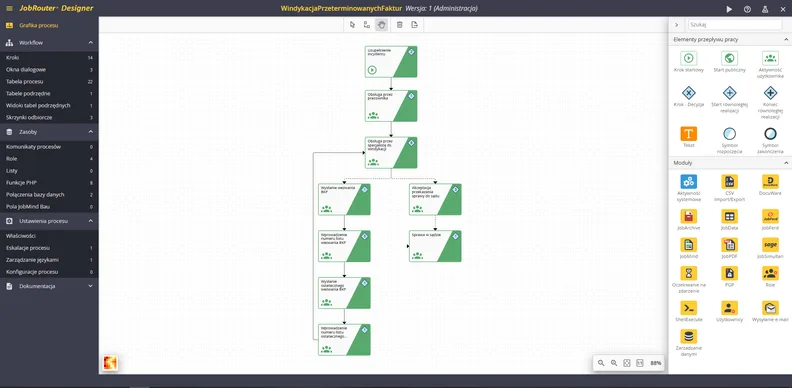
We started with the simplest ones. The first of them were up and running a week after the implementation. Holiday requests, advance payment requests and work requests between departments were digitised the fastest. This clearly sped up and streamlined our daily work. We have now streamlined more than 50 different processes. The most important ones are:
- automation of purchase invoices,
- automation of payment reminders and sales invoices,
- automation of production and logistics orders,
- measurement of production output and the efficiency of production departments,
- automation of business trips,
- automation of holiday requests.
Which processes required more effort?
Big processes also mean big challenges. The ones that required – and still require – the most attention are those related to measuring the efficiency of the production process.
The JobRouter platform has countless applications. You can digitise anything with it. From our point of view, however, not everything makes sense, so we focused on the processes that matter most to us and that deliver the best results.
Did the implementation require integration with other online systems?
Integrations with other systems are an inseparable part of the process digitisation project in our company. The most important one was, of course, the integration with Comarch CDN XL. Others included Webfleet TOMTOM Telematics, Google Analytics, G Suite, Focus Contact Center and Google Data Studio.
What measurable benefits has process automation brought us?
Putting our processes in order and aggregating our data for later analysis was very important to us. Well-organised processes mean fewer mistakes and errors and less room for interpreting processes in different ways. In a broader sense, digitisation means cost optimisation and better use of time and work efficiency. The time we save can be used in any way we like – for example to develop our offer.
A very measurable example of automation is the digitisation of invoice dispatch, i.e. replacing paper invoices with electronic ones. But that is just the tip of the iceberg.
A great example is the automation of payment reminders for sales invoices. This change has improved how promptly our business partners pay. For instance, in January this year two thirds of all overdue payments were recovered through automatic reminders, without any human involvement.
For the Sales Department, whose staff travel a lot, the automation of business-trip documents made a difference. The time saved by improving this process can now be used for tasks such as acquiring new customers.
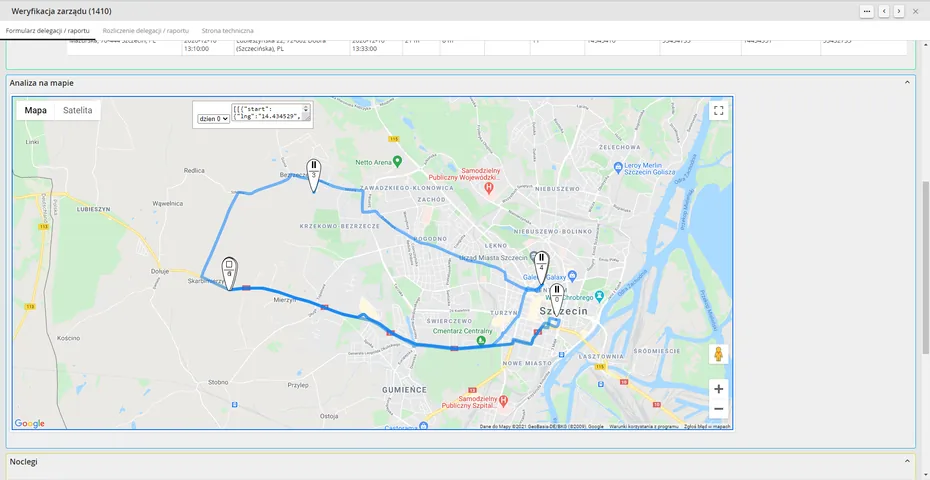
For the Service Department, automation led to a planner for service technicians’ trips. As a result, we have optimised their routes and travel times.
For our customers, in turn, the launch of electronic repair reports confirmed by the customer with an SMS code was important. This change has shortened the time needed to handle a service request and improved the quality of customer service.
How has automation improved our customers’ experience?
We are glad that digitising the customer service processes in our company has improved our customers’ experience of our brand. All of this has a significant impact on how customers perceive BKF. We all know that a satisfied customer is a customer who will always be happy to come back to us.